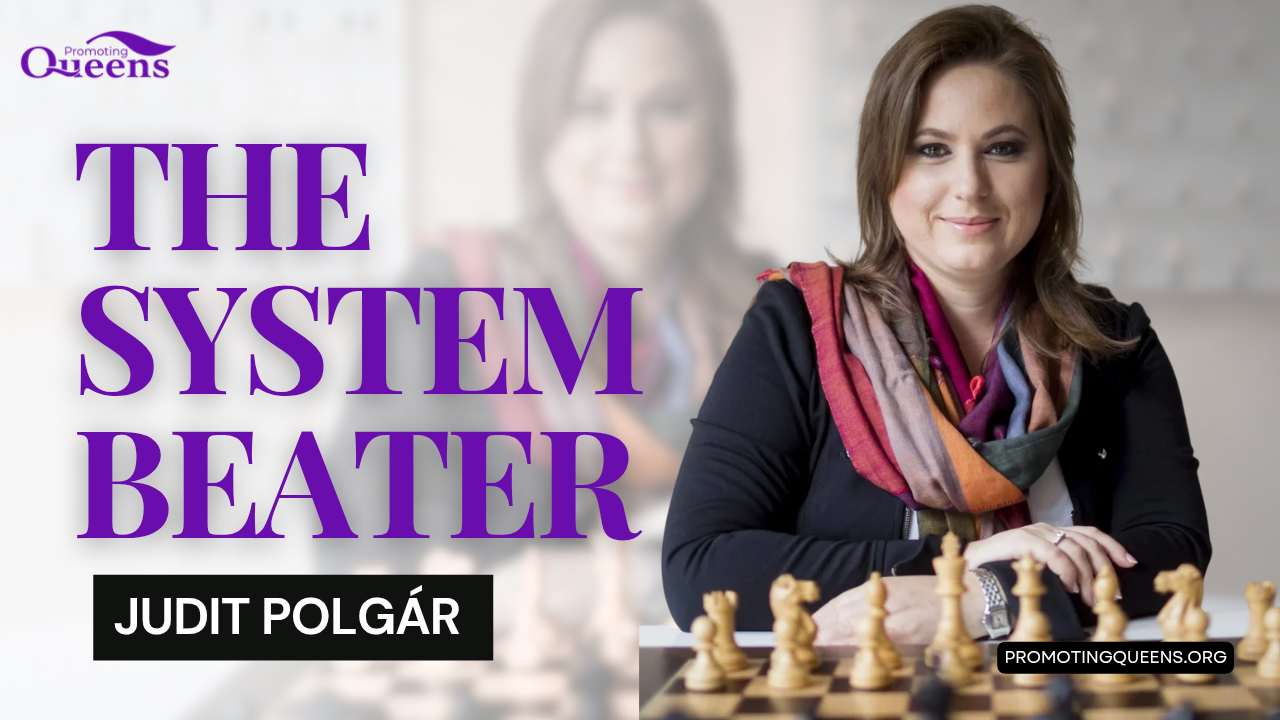
THE SYSTEM BEATER: JUDIT POLGÁR
She was fourteen when she decided the women's category wasn't big enough for her. By the time the chess world caught up, she had already beaten eleven world champions.
So who is Judit Polgár?
Judit Polgár was born on July 23, 1976, in Budapest, Hungary. She is the greatest female chess player who has ever lived. She won in a room that wasn't built for her, against people who didn't expect her, and on a stage she had to choose for herself.
How Did She Start?
Her father László believed genius wasn't born, it was built. He chose chess early for his three daughters: any child, given the right environment and enough focused hours, could become exceptional. The Polgár girls were homeschooled. Chess wasn't a hobby. It was the curriculum.
At seven, Judit played a chess master blindfolded and won. At nine, she entered the New York Open against adult expert-level players and won that too. By twelve she was inside the world's top 100, not the women's ranking, the overall one. The British Chess Magazine wrote that her results made Fischer and Kasparov's performances at the same age "pale by comparison."
She wasn't a prodigy who got lucky. She was a child who was taken seriously.
What Has She Achieved?
At fifteen she became a Grandmaster, breaking Bobby Fischer's 33-year-old record. In 2002 she beat Garry Kasparov, the world No. 1, rated 2849, the first woman in history to beat a reigning world No. 1 in competitive play. By her retirement in 2014, she had beaten eleven world champions. Her peak rating of 2735 made her the only woman ever to cross 2700. She held the world's top women's ranking for twenty-six consecutive years without ever competing for it. In 2026, Netflix released a documentary, Queen of Chess, about her life.
Why Should You Care?
Because at some point someone might hand you a smaller table. It won't look like a limitation, it will look like an opportunity. Only you can feel the difference between a structure that grows you and one that simply contains you.
The girls we work with in Nigeria and Kenya are sitting at tables that were built small for them too. Sometimes it's the assumption in a classroom. Sometimes it's who gets taken seriously at a chess board. Sometimes it's the quiet message that ambition, for a girl, should come with an asterisk.
Judit Polgár felt that difference at fourteen. She chose the bigger table. She became the best who ever did it.
At Promoting Queens, we believe chess teaches girls to recognise the full size of their own potential and to refuse anything less.
If this story moved you, there's something you can do about it.
Support the girls we're building this for. Donate, Volunteer, or Partner With Us. Every contribution keeps chess in the hands of girls who need it most.